
Personalized Tirzepatide Dosing in Spokane
There’s a kind of medicine where everyone gets the same dose at the same intervals because that’s what the box says. It’s efficient. It’s also why a 5’2" woman with hypothyroidism gets the same starting protocol as a 6’1" man with insulin resistance, and why both of them sometimes wonder why their results are so different.
Personalized Tirzepatide protocols exist for a reason. The drug works in everyone who responds, but how it works in any specific person is a function of body composition, hormone status, insulin sensitivity, prior medication exposure, sleep quality, and approximately fifteen other variables a fixed-dose schedule cannot account for.
Below is what personalized actually means clinically, what it doesn’t mean (despite the marketing), and what to expect from a real workup.

What “Personalized Protocol” Should Actually Mean
The phrase is heavily abused. Many telehealth platforms call their service “personalized” because a chatbot asked you three questions about your weight goals before generating a prescription identical to the one it generated for the previous 200 patients. That is not personalization. That is volume processing with a marketing layer.
Personalization in a clinical context means at minimum:
Comprehensive baseline labs — not just A1C and a metabolic panel
A full medical history including medications, prior weight-loss attempts, hormonal context, and family history
Body composition assessment — body fat percentage, lean mass, ideally a DEXA or InBody scan
A starting dose, titration cadence, and ceiling chosen for your metabolism, not the manufacturer’s average
Adjustments based on your response, not a fixed calendar
Adjacent factors addressed in parallel — thyroid, sex hormones, sleep, training
If your “consultation” did not include the first three, your protocol is not personalized. It is, at best, prescription delivery.
The Baseline Workup We Run at Prime Body Solutions if Needed
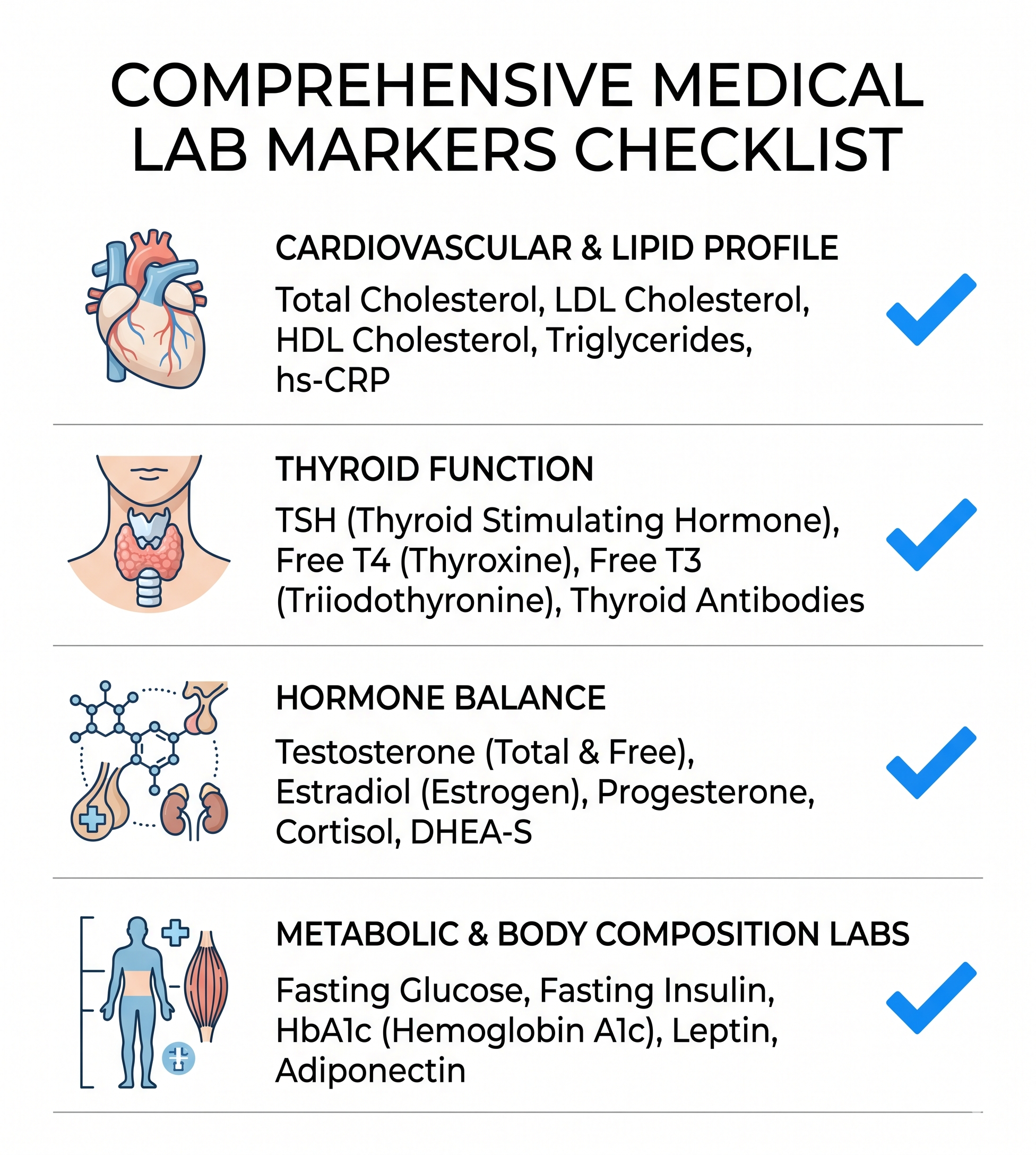
Before a single Tirzepatide injection happens, the workup typically includes:
Metabolic & Diabetes Markers
Hemoglobin A1C
Fasting glucose
Fasting insulin
Comprehensive metabolic panel
Lipid & Cardiovascular Markers
Full lipid panel (LDL, HDL, triglycerides, total)
ApoB and Lp(a) where indicated
High-sensitivity CRP- if indicated
Thyroid Panel
TSH, Free T4, Free T3
(Reverse T3 and antibodies if indicated — patients with subclinical thyroid issues respond differently to Tirzepatide, and this is missed constantly)
Sex Hormones (Especially in Men + Perimenopausal/Postmenopausal Women)
Total and free testosterone
Estradiol, progesterone (in women)
SHBG, DHEA-S
(Why? Low testosterone, untreated perimenopause, and PCOS all blunt weight-loss response. Fix what’s broken before blaming the drug.)
Other Critical Markers
Vitamin D
B12
Ferritin & iron panel
Cortisol (4-point salivary or AM serum based on context)
Body Composition
InBody or comparable analyzer at baseline
Repeat monthly to track lean mass preservation, not just total weight loss
The whole point: the scale is the worst single metric for tracking metabolic health. A 30-lb loss that includes 8 lbs of muscle is not the same as a 30-lb loss that includes 1 lb of muscle. Body composition tells you which kind you’re getting.
How We Customize the Titration
The standard manufacturer titration is: 2.5 → 5 → 7.5 → 10 → 12.5 → 15 mg, advancing every 4 weeks. That schedule was designed for clinical-trial cohorts. It is not the only valid schedule, and in real practice we frequently modify it based on:
Slower titration when the patient:
Has a sensitive GI history (IBS, gastroparesis, prior bariatric surgery)
Is on multiple medications that interact with gastric emptying
Has a small frame with low total body weight
Reports significant nausea at the current dose
Prefers gentler progression and is willing to trade speed for tolerance
Faster titration is rarely appropriate and we mostly don’t do it. The data does not support it, and the side-effect curve gets ugly fast.
Hold at a sub-maximal dose when:
Patient is losing 0.75–1.25% of body weight per week (the “metabolic sweet spot” most patients hit at 5–10 mg)
Tolerance is good and labs are improving
Pushing higher would risk excess lean mass loss
Long-term cost considerations favor a stable lower dose
Decrease the dose when:
Patient is losing too fast (>2.5% body weight per week — this triggers metabolic adaptation and lean mass loss)
Side effects are interfering with function
Goal weight is approaching and the maintenance plan is being designed
The phrase “highest tolerated dose” — which you’ll see in many telehealth protocols — is not actually evidence-based. The phrase you want is “lowest dose that maintains progress.”
Want a Real Workup, Not a Triage Form?
Prime Body Solutions runs full diagnostic panels, body composition analysis, and physician-led titration as part of every Tirzepatide consultation. Initial visit can includes labs, history, body comp, and a written protocol you can keep — even if you decide not to proceed.
Schedule your consultation or call (509) 601-4700.
The Adjacent Factors Most Clinics Skip
Personalization is not just dosing. It’s everything that runs in parallel.
Hormone optimization. Patients with low testosterone (men) or hormonal dysregulation (perimenopausal women, PCOS) consistently lose weight more slowly on Tirzepatide. Addressing the hormones first — or in parallel — improves response substantially. We’ve written more about this in Tirzepatide + hormone optimization.
Protein targeting. A patient hitting 60 g protein per day on Tirzepatide will lose more lean mass than one hitting 130 g. The medication makes hitting protein harder (because of reduced appetite), so the target needs to be deliberate, not casual.
Resistance training. Two sessions per week of structured strength work is the single most effective intervention for preserving lean mass during GLP-1 weight loss. It is not optional, even if it feels optional.
Sleep. Sleep under 6 hours per night blunts weight-loss response measurably. Sleep should be a main priority for overall health and wellnesss.
Adherence support. Weekly injections sound simple until you forget the third one. We try to make our patients understand the importance of dosing schedule.
De-escalation planning. From day one, we discuss the exit ramp. The clinical goal is not “stay on Tirzepatide forever.” It’s “use Tirzepatide as the metabolic correction tool, then transition to maintenance with the lowest medical input necessary.” See long-term maintenance for more.
How We Know the Protocol Is Working
The benchmarks we track at every visit:
Marker Goal Range Weight loss rate 0.75–1.5% per week (slower is fine; faster is concerning) Lean mass retention ≥85% of total weight loss should be fat mass Energy & sleep Subjective improvement HRV / resting HR Stable or improved A1C / fasting insulin Improving toward optimal range Blood pressure Improving Side effects Tolerable, not interfering with function Mood / cognition Stable or improved
If we’re missing on multiple markers, we don’t push the dose higher. We adjust the protocol — labs, dosing, lifestyle factors, or all three.
Frequently Asked Questions
What labs do I need before starting Tirzepatide?
At minimum but not always needed: A1C, fasting glucose, fasting insulin, complete metabolic panel, lipid panel, full thyroid panel (TSH, Free T3, Free T4), and sex hormones where appropriate. Vitamin D, B12, and ferritin are also worth running.
Can I get a personalized Tirzepatide protocol from a telehealth service?
Most telehealth platforms cannot run a full diagnostic panel or in-person body composition analysis. They can prescribe the medication and offer asynchronous adjustments, but “personalized” in the clinical sense requires lab-based decision making.
How often should I see my doctor on Tirzepatide?
A reasonable cadence is: full visit at week 4, week 8, then every 6–8 weeks during the loss phase, and quarterly during maintenance. Telehealth check-ins between visits are appropriate, but in-person body composition checks should happen every 12 weeks. At Prime Body Solutions, we want you in the office every month for a check in and repeat InBody composition analysis.
Why does my friend lose more weight than me on the same dose?
Different baseline metabolism, body composition, hormone status, sleep, training, protein intake, and dose-response sensitivity. Comparing yourself to another patient is rarely useful. Comparing yourself to your own labs and trajectory is.
What if I’m not losing weight on Tirzepatide?
The first step is not to increase the dose. The first step is to review labs (especially thyroid and sex hormones), protein intake, sleep, alcohol, and resistance training. Most “non-responders” become responders with a corrected protocol.
Personalization Is Clinical Work, Not Marketing.
The right Tirzepatide protocol for you is the one calibrated to your labs, your goals, and your real life — not the one a flowchart picked. Prime Body Solutions, located in Liberty Lake serving the entire Spokane metro, builds those protocols with full diagnostics and physician-led titration.
Schedule your consultation or call (509) 601-4700.
Medically reviewed by Dr. Cody Belkoff, DO — Medical Director, Prime Body Solutions
Last reviewed: May 2026
Prime Body Solutions | 2110 N Molter Rd, Suite 119, Liberty Lake, WA 99019 | (509) 601-4700
Serving Spokane, Spokane Valley, Liberty Lake, Post Falls, and Coeur d’Alene
Educational content only. Tirzepatide is a prescription medication requiring physician supervision.
