
Beyond the Number on the Scale: The Real Health Benefits of GLP-1 Therapy with Semaglutide and Tirzepatide
For most of our patients, the conversation starts with weight. They want to lose 30 pounds. They want their clothes to fit again. They want to feel comfortable in a photo.
Those are real, valid reasons. And we're going to help you get there.
But the more interesting story — the one we want every patient to understand before they start — is what reaching your ideal body weight actually does to the rest of your health. Because the cardiovascular, metabolic, hormonal, and emerging benefits of getting your body composition right are dramatically larger than most people realize. And the medications we use to get patients there — semaglutide and tirzepatide, the two leading GLP-1 receptor agonists — are turning out to do far more than help you eat less.
This is a primer on what the science actually shows. It's the conversation we have with patients in the consultation room, written down.
GLP-1 Therapy for Weight Loss and Metabolic Health
Quick Refresher: What GLP-1 Medications Actually Do
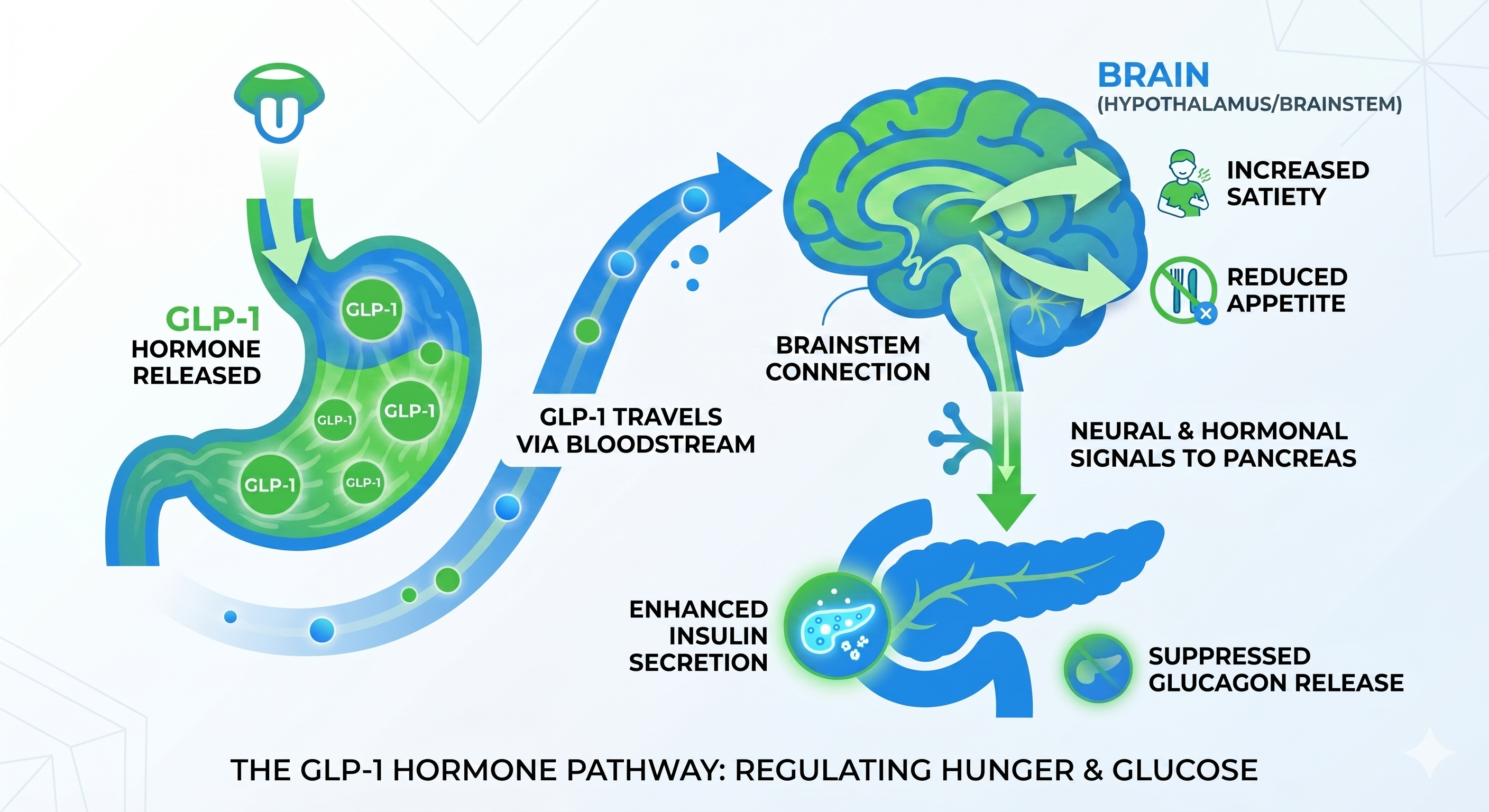
GLP-1 stands for glucagon-like peptide-1 — a hormone your body already makes in response to eating. It does several things at once:
Slows how fast your stomach empties (you feel full longer)
Signals your brain that you've had enough (the "food noise" quiets down)
Helps your pancreas regulate insulin and blood sugar
Reduces the constant pull toward hyperpalatable food
Semaglutide (the active ingredient in Ozempic and Wegovy) and tirzepatide (Mounjaro and Zepbound) are medications that mimic and amplify this signal. Tirzepatide goes a step further — it activates both GLP-1 and GIP receptors, which is part of why head-to-head data shows it producing greater average weight loss than semaglutide.
Both are FDA-approved, both require a prescription, and both work best inside a physician-supervised program with lab monitoring, nutrition guidance, and ongoing dose titration.
Part 1: What Reaching Your Ideal Body Weight Actually Does for Your Health
Before we get to what's specific to GLP-1s, let's talk about what any successful, sustained weight reduction does — because this is the foundation. The data on intentional weight loss in adults with overweight or obesity has been built up across decades of research, and the list is long.
Cardiovascular System
- Blood pressure drops. Most patients see meaningful systolic and diastolic reductions, often within weeks.
- Lipid profile improves. LDL down, triglycerides down, HDL up.
- Coronary artery disease risk falls. Lower body fat means lower vascular inflammation and less arterial stress.
- Atrial fibrillation risk drops for patients who reduce visceral fat.
Metabolic Health
- Insulin sensitivity returns. This is the foundation. Reversing insulin resistance changes everything downstream.
- A1C falls. For patients with prediabetes or type 2 diabetes, reaching ideal weight can put A1C back in normal range.
- Type 2 diabetes remission. A meaningful percentage of patients with newly diagnosed T2D can put it into remission with sustained weight loss.
- Fatty liver disease (MASLD/NAFLD) reverses. Liver fat clears with weight loss in most patients.
Hormonal Health
- Testosterone rises in men. Excess body fat is one of the largest drivers of low T — fat tissue converts testosterone into estrogen via aromatase. Reducing body fat reverses this.
- Cycle regularity returns in women. Many women with PCOS, anovulation, or irregular cycles see normalization.
- Fertility improves for both men and women.
- Menopausal symptom severity often decreases.
Joint and Structural
Every pound of weight is roughly four pounds of pressure on the knees during walking. Reducing body weight slows osteoarthritis progression and dramatically reduces joint pain. Lower back pain often resolves or significantly improves.
Sleep
Obstructive sleep apnea improves or resolves in many patients with weight loss. Sleep architecture itself improves — deeper sleep, more REM, less fragmentation.
Mental Health
Depression and anxiety scores improve in most patients who lose meaningful weight. Body image and self-efficacy improve, which compounds across the rest of life.
Cancer Risk
Reaching healthy body weight is associated with reduced risk of at least 13 different cancers, including breast, colon, endometrial, kidney, and esophageal — based on large cohort studies.

Longevity
Across population data, sustained weight reduction in adults with obesity is associated with lower all-cause mortality.
This is the baseline. It's what we'd expect from any successful weight loss intervention. But the GLP-1 story is bigger than that — and this is where the research has gotten genuinely surprising.
Part 2: The Hidden and Emerging Benefits of GLP-1 Therapy
Here's where the last three years of research have rewritten the textbook. We're now seeing benefits from semaglutide and tirzepatide that go beyond what weight loss alone explains — meaning the medications appear to be doing something additional in the body.
Cardiovascular Protection — Independent of Weight Loss
The SELECT trial (2023) followed more than 17,000 adults with obesity and pre-existing cardiovascular disease but without diabetes. Patients on semaglutide had a 20% reduction in major adverse cardiovascular events (heart attack, stroke, cardiovascular death) compared to placebo. The reduction began emerging within months — earlier than weight loss alone could explain. This led to the FDA expanding semaglutide's indication to include cardiovascular risk reduction in adults with obesity.
For patients in the Spokane area asking us "is this just for weight?" — this is the answer. It's not.
Kidney Protection
The FLOW trial (2024) showed that semaglutide reduced kidney disease progression by 24% in adults with type 2 diabetes and chronic kidney disease. This is significant — kidney decline is one of the biggest drivers of long-term morbidity in diabetic patients.
Sleep Apnea — FDA-Approved Indication
In late 2024, the FDA approved tirzepatide for the treatment of obstructive sleep apnea in adults with obesity. The pivotal SURMOUNT-OSA trials showed dramatic reductions in apnea events — many patients reduced their CPAP requirements or no longer met clinical criteria for OSA. This is the first medication to receive an OSA indication.
Reduced Cravings — Beyond Food
This one surprised researchers. Patients on GLP-1 therapy report reduced cravings not just for food, but for alcohol, nicotine, and even gambling in some cohorts. Early data and ongoing trials suggest GLP-1 receptors in the brain's reward pathways are part of a much broader craving regulation system. There are now active clinical trials evaluating GLP-1 medications for alcohol use disorder.
Anti-Inflammatory Effects
Both semaglutide and tirzepatide reduce systemic inflammatory markers (CRP, IL-6) in studies. Chronic low-grade inflammation is a driver of nearly every age-related disease, so the implications for long-term health are substantial — though we're still mapping the full picture.
MASLD / NAFLD (Fatty Liver) Reversal
In dedicated liver studies, semaglutide produced significant reductions in liver fat and improvements in liver fibrosis markers. Tirzepatide is showing even more pronounced effects in ongoing trials. This matters because fatty liver disease is now one of the most common chronic diseases in American adults — and historically had no good pharmacologic treatment.
Brain Health and Dementia Research
This is where we want to be cautious — the data is still emerging. But large observational studies have shown patients on GLP-1 medications have lower rates of cognitive decline and Alzheimer's diagnosis compared to matched controls. There are now Phase 3 trials specifically evaluating semaglutide for early Alzheimer's. We don't have answers yet, but the signal is strong enough to take seriously.

PCOS
Women with polycystic ovary syndrome are seeing significant improvement in symptoms — cycle regularity, androgen levels, insulin resistance — on GLP-1 therapy. For many of our female patients, weight is downstream of PCOS, and treating both together changes outcomes.
"Food Noise" Reduction — A Quality-of-Life Benefit You Can't Measure on Labs
Almost every patient describes this within the first few weeks: the constant background hum of food thoughts quiets down. The reflexive snack at 9 p.m. is gone. The 3 p.m. drive-thru pull weakens. This is a real neurological effect — GLP-1 receptors in the brain modulate reward signaling. Patients who have struggled with food obsession for decades describe it as life-changing in a way that's hard to convey.
Why Physician-Led Care Matters — Especially with These Medications
The medications work. But how they're used determines whether you get the full benefit or end up with a bad experience.
In a Physician-Led Program, You Get:
- A real medical evaluation — labs, comprehensive history, individual risk assessment. Not a 60-second telehealth questionnaire.
- The right medication selected for you. Semaglutide and tirzepatide are different drugs with different profiles. Some patients respond better to one. Some have side-effect tolerance issues that determine the choice.
- Proper dose titration. Most side effects come from going up too fast. A physician-supervised program titrates carefully, often slower than the package insert suggests, especially for sensitive patients.
- Body composition tracking — so you're losing fat, not muscle. This is the difference between coming out healthier and coming out skinnier-but-fragile.
- Lab monitoring. Lipids, A1C, kidney function, hormone panels. Real data on whether the program is working at the metabolic level — not just the scale.
- Nutrition and resistance-training guidance to preserve lean mass.
- Unlimited physician access — questions answered by a physician, not a triage line.
This is what we built Prime Body Solutions around. Medical weight loss is a medical program. It should be run like one.
What About Side Effects?
We'd be doing you a disservice if we didn't address this directly. The most common side effects of semaglutide and tirzepatide are:
- Nausea — usually mild, usually resolves within a few weeks of each dose increase.
- Constipation — manageable with hydration, fiber, and adjustment.
- Reduced appetite — this is the desired effect, but for some patients it's so strong they need to be reminded to eat enough protein.
Less Common but Important:
- Gallbladder issues in patients with rapid weight loss.
- Pancreatitis — rare but real. Patients with a history of pancreatitis are typically not candidates.
- Muscle loss — preventable with proper nutrition and resistance training, which is why we build that into the program.
These medications are not for everyone. Patients with certain thyroid cancer histories, certain pancreatic conditions, certain GI issues, or pregnancy are not candidates. This is part of what the physician evaluation is for — to figure out whether the program is actually right for you.
What It Actually Costs (and Why Insurance Is Complicated)
We'll give you a straight answer in the consultation. Pricing depends on which medication, your insurance situation, and your program length. Some patients have insurance coverage. Many don't — but cash-pay programs at our clinic remain accessible compared to most direct-to-consumer programs because we use compounded options where appropriate and brand-name products where they're necessary.
We'll show you the actual numbers in your free consultation. No surprises.
The Bottom Line
Reaching your ideal body weight changes more than your reflection. It changes your cardiovascular risk, your metabolic future, your hormone profile, your joint health, your sleep, your mental health, and your long-term mortality risk.
GLP-1 therapy with semaglutide or tirzepatide, in a physician-supervised program, is the most effective pharmacologic tool we've ever had to help patients get there sustainably. And as the research keeps coming in, we're learning the medications themselves do more than just enable weight loss — they appear to protect the heart, the kidneys, the liver, and possibly the brain.
But none of this happens by ordering a vial off a website. It happens inside a real medical program, with real labs, real follow-up, and a physician who knows your case.
If you're in Spokane, Spokane Valley, Liberty Lake, Coeur d'Alene, or anywhere in Washington via telehealth — we'd be glad to talk.

Book your free consultation
A physician-led conversation about your goals, your health history, and whether a medical weight loss program with GLP-1 therapy is the right fit. No pressure. No commitment. Just real information from a physician.
Book your free consultation today. Telehealth available across Washington. In-clinic at our Liberty Lake location.
*Important medical disclaimers: Physician evaluation required to determine candidacy. Not all patients are candidates for GLP-1 therapy. Individual results vary based on adherence, dosing, underlying health conditions, and lifestyle factors. Semaglutide and tirzepatide are prescription medications with potential side effects and contraindications. This article is educational and is not medical advice. Always discuss any medication, including GLP-1 therapy, with your physician before starting treatment.*
---
**About Prime Body Solutions**
Prime Body Solutions is a physician-led medical clinic in Liberty Lake, Washington, specializing in medical weight loss, hormone optimization, peptide therapy, and longevity. We serve patients across Spokane, Spokane Valley, Liberty Lake, Coeur d'Alene, Post Falls, and the greater Inland Northwest — and via telehealth statewide.
2110 N Molter Rd Suite 119, Liberty Lake, WA 99019
https://www.primebodysolutions.com

